Table of Contents
- Introduction
- What Is SEO and How Does It Work?
- What Are Paid Ads and How Do They Work?
- Key Advantages of SEO for Business Owners
- Key Advantages of Paid Advertising
- Cost Comparison: SEO vs Paid Ads
- When to Use SEO vs When to Use Paid Ads
- The Hybrid Approach: Best of Both Worlds
- Budget Allocation by Business Stage
- Choosing the Right Digital Marketing Partner
- Frequently Asked Questions
Introduction
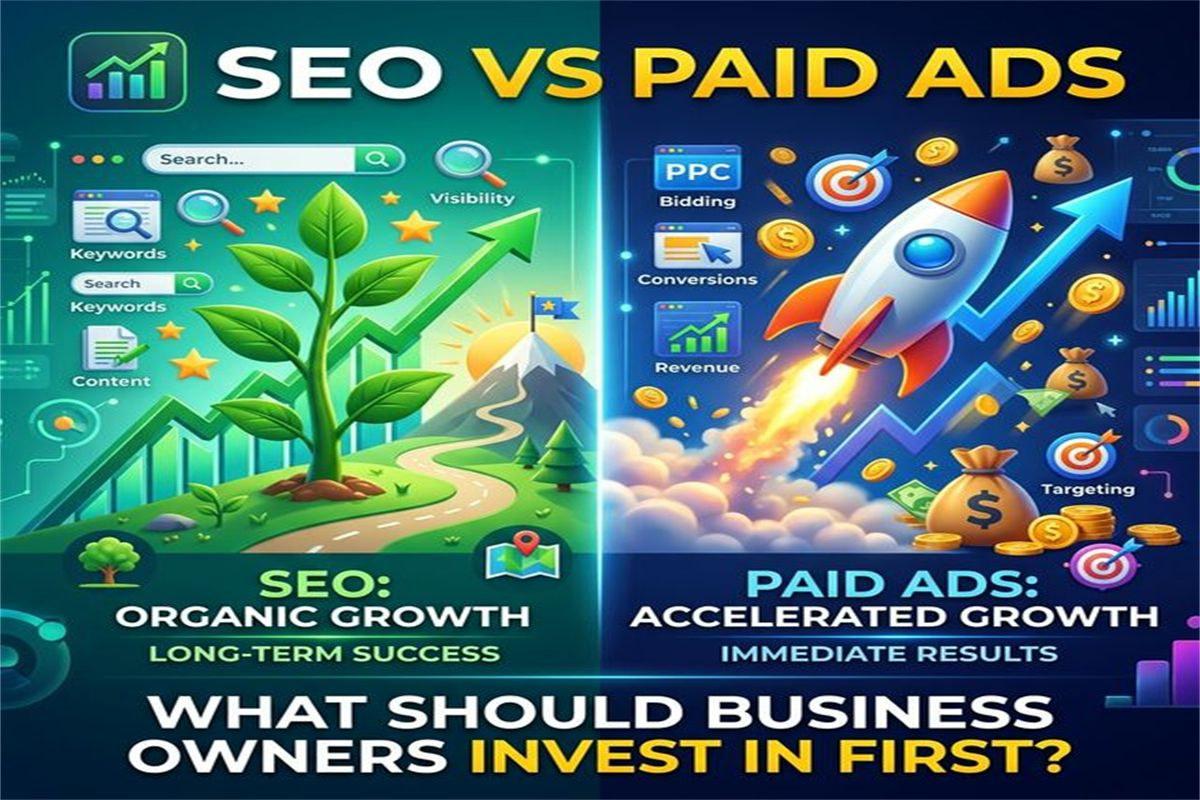
One of the most common questions business owners face when entering the digital marketing space is whether to invest in SEO or paid advertising first. It is a critical decision that can shape the trajectory of your online growth, directly impacting your lead flow, revenue, and brand visibility for months or even years to come.
The truth is, both SEO and paid ads are powerful channels. But they serve different purposes, operate on different timelines, and demand different levels of investment. Making the wrong choice at the wrong stage of your business can mean wasted budgets, missed opportunities, and frustrating stagnation.
In this comprehensive guide, we break down the strengths and limitations of both channels, compare their costs and returns, and help you decide exactly where to put your marketing dollars based on your business stage, goals, and budget. Whether you are a startup looking for quick wins or an established company seeking sustainable growth, this article will give you the clarity you need.
What Is SEO and How Does It Work?
Search Engine Optimization (SEO) is the practice of optimizing your website, content, and online presence to rank higher in organic (non-paid) search engine results. When someone searches for a product, service, or question related to your business, SEO determines whether your website appears on page one of Google or gets buried on page five where no one looks.
SEO is a multifaceted discipline that encompasses several core areas. On-page SEO involves optimizing your website's content, meta tags, headings, internal linking, and overall structure to align with search engine algorithms. Technical SEO focuses on site speed, mobile responsiveness, crawlability, and indexation, ensuring search engines can access and understand your content. Off-page SEO includes link building, brand mentions, and authority-building activities that signal to Google that your website is trustworthy and relevant.
Working with a professional SEO company ensures that all three pillars are addressed strategically. A solid SEO foundation does not just bring traffic; it brings the right traffic, people actively searching for what you offer. This intent-driven traffic is what makes organic search one of the highest-converting marketing channels available.
Additionally, local SEO services play a crucial role for businesses targeting customers in specific geographic areas. By optimizing your Google Business Profile, building local citations, and targeting location-specific keywords, you can dominate the local search results and attract nearby customers who are ready to buy.
What Are Paid Ads and How Do They Work?
Paid advertising, often referred to as PPC (pay-per-click) or SEM (search engine marketing), involves paying for your website to appear at the top of search results, social media feeds, or display networks. Unlike SEO, which earns visibility over time, paid ads buy immediate placement in front of your target audience.
The most popular paid advertising platforms include Google Ads, Meta Ads (Facebook and Instagram), LinkedIn Ads, and YouTube Ads. Each platform offers unique targeting capabilities that allow you to reach specific demographics, interests, behaviors, and even people who have previously visited your website.
Google Ads management is particularly powerful for capturing high-intent search traffic. When someone searches for "best accounting software for small business" and clicks on a Google Ad, they are already deep in the buying journey. This makes search ads incredibly effective for generating leads and sales quickly.
Professional PPC management services go beyond simply setting up campaigns. They involve continuous keyword research, bid optimization, ad copy testing, landing page optimization, and performance analysis to maximize every dollar you spend. Without expert management, ad budgets can be wasted on irrelevant clicks and poorly optimized campaigns.
Key Advantages of SEO for Business Owners
1. Compound Growth Over Time
SEO is often compared to compound interest in investing. The effort you put in today continues to generate returns months and years down the line. A blog post you publish today, if well-optimized, can bring in hundreds or thousands of visitors per month for years without any additional cost. This compounding effect is what makes SEO the most sustainable marketing channel for long-term business growth.
2. Lower Cost Per Acquisition
While SEO requires an upfront investment in content marketing services, technical optimization, and link building, the cost per lead decreases dramatically over time. Once you rank for your target keywords, the traffic you receive is essentially free. In contrast, paid ads require continuous spending; stop paying, and the traffic stops immediately.
3. Higher Trust and Credibility
Studies consistently show that users trust organic results more than paid ads. Appearing in the top organic positions signals to potential customers that your business is authoritative and trustworthy. This trust factor directly impacts click-through rates and conversion rates, giving SEO-driven traffic a qualitative edge.
4. Full-Funnel Visibility
A well-executed content strategy allows you to capture traffic at every stage of the buyer's journey, from awareness (informational searches) to consideration (comparison searches) to decision (transactional searches). This full-funnel approach nurtures potential customers from first touch to final conversion.
5. Sustainable Competitive Advantage
Strong organic rankings are difficult for competitors to displace quickly. While a competitor can outbid you on Google Ads overnight, they cannot outrank you organically without months of sustained effort. This makes SEO a defensible competitive moat for your business.
Ready to Build a Sustainable SEO Strategy?
Our team of SEO experts will create a customized strategy that drives organic traffic, leads, and revenue growth for your business.
Get a Free ConsultationKey Advantages of Paid Advertising
1. Instant Visibility and Traffic
The biggest advantage of paid ads is speed. You can launch a Google Ads campaign in the morning and start receiving clicks by the afternoon. For businesses that need leads immediately, whether it is a product launch, seasonal promotion, or a new market entry, paid ads deliver results faster than any other channel.
2. Precise Audience Targeting
Paid advertising platforms offer granular targeting options that SEO simply cannot match. You can target users by age, gender, location, income level, interests, purchase behavior, job title, and much more. Facebook & Instagram advertising is particularly powerful for reaching highly specific audience segments with visual, engaging ad creatives.
3. Scalability on Demand
With paid ads, scaling is straightforward. If a campaign is profitable, you can increase the budget and proportionally increase results. This linear scalability makes pay-per-click advertising ideal for businesses with aggressive growth targets and the budget to support them.
4. Measurable and Transparent ROI
Paid advertising platforms provide detailed performance data, including impressions, clicks, conversions, cost per conversion, and return on ad spend (ROAS). This transparency makes it easy to calculate exactly how much revenue each dollar of ad spend generates, allowing for data-driven budget decisions.
5. Testing and Market Validation
Paid ads are an excellent tool for testing new markets, products, or messaging before making larger investments. You can run small-budget campaigns to validate demand, test different value propositions, and identify your best-performing audiences before committing to long-term strategies.
Cost Comparison: SEO vs Paid Ads
Understanding the true cost of each channel requires looking beyond the surface. Many business owners compare monthly SEO fees to monthly ad spend, but this comparison misses the bigger picture.
SEO typically costs between INR 15,000 to INR 1,00,000+ per month depending on the scope and competitiveness of your industry. This investment covers content creation, technical optimization, link building, and ongoing monitoring. The key difference is that SEO is an appreciating asset. The content you create, the authority you build, and the rankings you earn continue to deliver value long after the initial investment.
Paid ads, conversely, are a depreciating expense. A typical Google Ads campaign might cost INR 20,000 to INR 5,00,000+ per month in ad spend alone, plus management fees. The moment you pause the budget, all traffic and leads stop. There is no residual value from past ad spend.
Consider this scenario: after 12 months of SEO investment, your website might be generating 10,000 organic visitors per month at zero per-click cost. Achieving the same traffic through Google Ads might cost INR 2,00,000 or more per month. Over 3 to 5 years, the cost advantage of SEO becomes enormous.
However, paid ads have a cost advantage in the short term. If you need 100 leads this month, Google Ads services can deliver them far faster than SEO. The key is understanding your business timeline and matching your investment to your goals.
When to Use SEO vs When to Use Paid Ads
Choose SEO When:
- You are building a business for the long term and want sustainable growth
- Your industry has high cost-per-click rates that make paid ads expensive
- You want to build authority, trust, and brand recognition in your niche
- You have the patience to wait 3 to 6 months for results to compound
- You want to reduce dependency on paid channels over time
- Your target audience actively searches for solutions online
For businesses in this category, investing in best SEO services in India is the most impactful long-term decision you can make.
Choose Paid Ads When:
- You need leads and sales immediately (product launch, seasonal offer)
- You are entering a new market and need to validate demand quickly
- Your competitors dominate organic search and it will take time to catch up
- You have a clear budget and want measurable, predictable results
- You are running time-sensitive promotions or events
- You want to retarget website visitors who did not convert
The Hybrid Approach: Best of Both Worlds
The most successful digital marketing strategies do not rely on a single channel. They combine SEO and paid ads in a strategic hybrid approach that maximizes short-term results while building long-term assets.
Here is how a hybrid strategy works in practice:
Phase 1 (Months 1 to 3): Launch paid ad campaigns on Google and social media to generate immediate traffic and leads. Simultaneously, begin SEO work including website audit, technical fixes, content strategy development, and initial content creation. Use paid ad data (search terms, audience insights) to inform your SEO keyword strategy.
Phase 2 (Months 3 to 6): Continue running paid ads while your SEO efforts start gaining traction. Publish high-quality, SEO-optimized blog content regularly. Build backlinks through outreach and PR. Use content marketing services to create comprehensive resources that attract organic traffic.
Phase 3 (Months 6 to 12): As organic rankings improve and organic traffic grows, begin reducing paid ad spend on keywords where you now rank organically. Redirect saved budget to new keyword opportunities or different ad platforms like Meta ads management or YouTube marketing services.
Phase 4 (Month 12+): Maintain a balanced portfolio where SEO drives the majority of traffic and leads, while paid ads are used strategically for retargeting, new market testing, and competitive keywords where organic ranking is difficult.
Budget Allocation by Business Stage
Startups and New Businesses
Budget is tight and immediate results are critical. Allocate 60% to paid ads and 40% to foundational SEO work. The focus should be on validating your market, generating initial revenue, and building a website that is technically optimized for future SEO growth. Invest in local search optimization if you serve a specific geographic area, as local SEO often delivers faster results than national SEO.
Growing Businesses (1 to 3 Years)
You have initial traction and need to scale efficiently. Shift to 50% SEO and 50% paid ads. Invest heavily in content creation, on-page optimization, and link building while maintaining profitable ad campaigns. This is the stage where the compounding effects of SEO begin to deliver significant returns.
Established Businesses (3+ Years)
Your organic presence should be strong by now. Allocate 60 to 70% to SEO and content marketing, and 30 to 40% to paid ads for strategic campaigns. Use paid ads primarily for retargeting, new product launches, and competitive market segments. Your cost per lead from organic traffic should be significantly lower than paid channels.
Choosing the Right Digital Marketing Partner
Whether you choose SEO, paid ads, or both, the quality of execution matters more than the channel itself. A poorly managed SEO campaign will waste months, and a poorly managed ad campaign will burn through budget with nothing to show for it.
Look for a digital marketing partner that offers integrated services across both channels. At Cognivic Digital, we provide end-to-end solutions including professional SEO company services, Google Ads management, PPC management services, social media marketing, and content marketing services. Our data-driven approach ensures your marketing budget delivers maximum returns regardless of the channel mix.
We also provide complementary services like professional web development and landing page design to ensure your website converts the traffic you generate. After all, driving traffic to a poorly designed website is like pouring water into a leaky bucket.
Read more expert insights on our digital marketing blog to stay ahead of the latest trends and strategies.
Ready to Maximize Your Marketing ROI?
Our experts will analyze your business goals, competition, and budget to recommend the ideal mix of SEO and paid ads for maximum growth.
Get a Free ConsultationFrequently Asked Questions