Table of Contents
- Introduction
- What ROI Really Means in Digital Marketing
- Measuring SEO ROI
- Calculating PPC and Google Ads ROI
- Social Media Marketing ROI
- Content Marketing ROI
- Channel-Wise ROI Breakdown
- Tools for Tracking Digital Marketing ROI
- Setting Realistic Expectations
- Strategies to Maximize Your ROI
- Frequently Asked Questions
Introduction
Every business owner who invests in digital marketing eventually asks the same fundamental question: "Is this actually working?" It is a fair question. Marketing budgets are significant line items, and without clear visibility into returns, it is natural to feel uncertain about whether your investment is paying off.
The challenge is that digital marketing ROI is not always straightforward to measure. Unlike placing an ad in a newspaper and counting phone calls, digital marketing involves multiple channels, complex attribution models, and varying timelines. A social media post today might lead to a website visit next week, which might result in a purchase next month. Connecting those dots requires the right tools, metrics, and mindset.
In this comprehensive guide, we will demystify digital marketing ROI. You will learn exactly how to measure returns from each major channel, which metrics matter most, what tools to use, and how to set realistic expectations based on your investment level and business stage. By the end, you will have the knowledge to evaluate your marketing performance with confidence and make smarter investment decisions.
What ROI Really Means in Digital Marketing
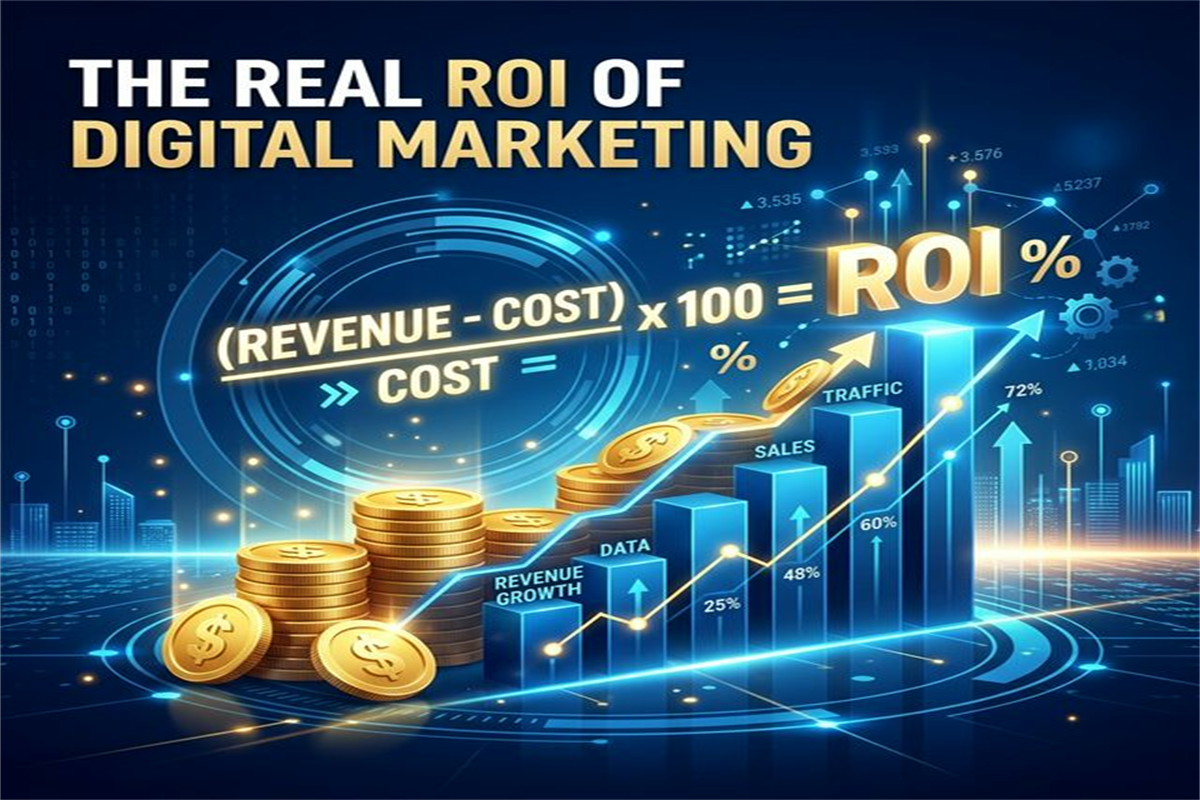
Return on Investment (ROI) in digital marketing is the ratio of profit generated from your marketing activities relative to the cost of those activities. The basic formula is simple: ROI = (Revenue from Marketing - Cost of Marketing) / Cost of Marketing x 100.
However, digital marketing ROI extends beyond this simple calculation. There are direct returns (leads, sales, revenue) and indirect returns (brand awareness, customer trust, market positioning) that contribute to long-term business value. A well-crafted piece of content might not generate a sale today, but it builds trust and authority that leads to sales over the next 12 months.
Understanding ROI also requires distinguishing between short-term and long-term returns. Google Ads services might deliver measurable returns within the first month. Professional SEO company strategies might take six months to show positive returns but then compound dramatically over the following years. Evaluating both channels on a one-month timeline would be misleading.
Smart business owners look at ROI across three dimensions: immediate returns (this month's revenue from marketing spend), cumulative returns (total revenue generated over time from a marketing investment), and asset value (the long-term worth of rankings, content, email lists, and brand equity built through marketing efforts).
Measuring SEO ROI
SEO is often considered the highest-ROI digital marketing channel, and for good reason. Once you achieve strong organic rankings, the traffic you receive is essentially free, no per-click costs, no per-impression fees. The challenge is that SEO requires upfront investment before the returns materialize.
How to Calculate SEO ROI
To calculate SEO ROI accurately, you need to track three key data points: your total SEO investment (agency fees, content creation costs, tools), the revenue generated from organic traffic, and the equivalent cost of that organic traffic if purchased through paid ads.
Revenue method: Track all conversions and revenue that originate from organic search traffic in Google Analytics. Subtract your total SEO costs to determine net profit. For lead-based businesses, assign a value to each lead based on your average conversion rate and deal size.
Traffic value method: Calculate the equivalent cost of your organic traffic if you had to pay for it via Google Ads. If you receive 10,000 organic clicks per month and the average cost-per-click for those keywords is INR 50, your organic traffic has an equivalent value of INR 5,00,000 per month. Compare this to your monthly SEO investment to understand the ROI.
Typical SEO ROI Timeline
Most businesses investing in best SEO services in India can expect the following timeline: Months 1 to 3 involve foundation building (technical fixes, content strategy, initial content) with minimal traffic gains. Months 4 to 6 show early ranking improvements and gradual traffic growth. Months 7 to 12 deliver significant ranking gains, substantial traffic increases, and positive ROI. Year 2 and beyond sees compounding returns where ROI typically exceeds 500% to 1000%.
Calculating PPC and Google Ads ROI
PPC advertising offers the most transparent and immediately measurable ROI of any digital marketing channel. Every click, conversion, and dollar spent is tracked in real-time, making it straightforward to calculate returns.
Key PPC ROI Metrics
Return on Ad Spend (ROAS): The most direct measure of PPC profitability. ROAS = Revenue from Ads / Ad Spend. A ROAS of 4:1 means you earn 4 rupees for every 1 rupee spent on ads. Most businesses target a ROAS of 3:1 to 5:1, though this varies significantly by industry and product margins.
Cost Per Acquisition (CPA): The average cost to acquire one customer through paid ads. CPA = Total Ad Spend / Number of Conversions. Compare your CPA to your customer lifetime value (CLV) to ensure profitability. If your CLV is INR 10,000 and your CPA is INR 2,000, each new customer generates a 5:1 return.
Cost Per Lead (CPL): For lead-generation businesses, CPL = Total Ad Spend / Number of Leads. Factor in your lead-to-customer conversion rate to determine the true cost of acquiring each paying customer.
Professional PPC management services focus relentlessly on improving these metrics through continuous optimization of keywords, ad copy, bidding strategies, and landing pages. Even small improvements in Quality Score or conversion rate can dramatically improve your ROI.
Optimizing PPC ROI
The difference between mediocre and exceptional PPC ROI often comes down to execution quality. Key optimization levers include negative keyword management (eliminating wasted spend on irrelevant searches), ad copy testing (continuously improving click-through rates), landing page design optimization (improving conversion rates), bid strategy refinement (maximizing conversions within budget), and audience targeting (focusing spend on your highest-value prospects).
Ready to Improve Your Digital Marketing ROI?
Our data-driven team will audit your current marketing efforts and identify opportunities to maximize your returns across every channel.
Get a Free ConsultationSocial Media Marketing ROI
Measuring social media marketing ROI is often considered more challenging because social media serves multiple purposes beyond direct sales, including brand awareness, community building, customer support, and audience engagement. However, with the right framework, social media ROI is absolutely measurable.
Direct Social Media ROI
Direct returns from social media include sales generated from social media traffic, leads captured through social media campaigns, and revenue from social commerce features (Instagram Shopping, Facebook Shops). Track these conversions using UTM parameters and goal tracking in Google Analytics.
Indirect Social Media ROI
Indirect returns include increased brand awareness (measured by reach, impressions, and brand mention volume), improved customer loyalty (measured by engagement rate, repeat visits, and sentiment), reduced customer support costs (through social media customer service), and enhanced SEO performance (through social signals and content amplification).
Paid social advertising through platforms like Meta ads management provides clearer ROI metrics similar to PPC, including ROAS, CPA, and CPL. Organic social media ROI is harder to quantify but becomes apparent through brand search volume growth, direct traffic increases, and higher conversion rates from brand-aware visitors.
Content Marketing ROI
Content marketing is a long-term investment that typically delivers the highest returns over time but requires patience in the early months. A well-executed content strategy generates returns through multiple mechanisms: organic traffic, lead generation, sales enablement, and brand authority.
Measuring Content Marketing Returns
Track these metrics for each piece of content: organic traffic generated, time on page and engagement, leads captured (form fills, downloads, signups), direct conversions attributed to content, and backlinks and social shares earned. Over time, you can calculate the revenue generated per blog post, guide, or video and compare it to the production cost.
The compounding nature of content marketing means a blog post that costs INR 5,000 to produce might generate INR 50,000 in attributed revenue over its lifetime. As your content library grows, the cumulative effect creates an ever-increasing stream of organic traffic and leads, making content marketing one of the most cost-effective long-term investments.
Channel-Wise ROI Breakdown
While every business is different, here are general ROI benchmarks for each major digital marketing channel:
SEO: Average ROI of 500% to 1200% over 2 to 3 years. Slow to start but compounds dramatically. Best for businesses focused on sustainable, long-term growth.
Google Ads: Average ROAS of 2:1 to 8:1 depending on industry and management quality. Immediate returns. Best for businesses needing quick leads and measurable performance. Professional Google Ads management is essential for maximizing returns.
Social Media Marketing: Variable ROI depending on organic vs paid. Organic social provides brand and engagement value that is difficult to quantify. Paid social typically delivers 3:1 to 6:1 ROAS for well-targeted campaigns.
Content Marketing: Average ROI of 300% to 800% over the first 2 years, increasing significantly as content assets compound. The initial investment period requires patience but delivers exceptional long-term value.
Email Marketing: The highest average ROI of any digital channel at approximately 3600% (36:1 ratio). However, this requires a quality email list built through other marketing channels, making it a complement rather than a standalone strategy.
Tools for Tracking Digital Marketing ROI
Accurate ROI measurement requires the right tools and proper setup. Here are the essential tools every business should use:
Google Analytics 4: The foundation of digital marketing measurement. Set up conversion tracking, e-commerce tracking, and attribution modeling to understand how each channel contributes to revenue. Use the multi-channel funnel reports to see the full customer journey.
Google Search Console: Essential for measuring SEO performance. Track organic impressions, clicks, average position, and click-through rates for your target keywords.
Google Ads Conversion Tracking: Implement conversion tags on your website to track leads and sales generated from your Google Ads campaigns. Connect Google Ads to Google Analytics for more detailed attribution data.
CRM Software: Tools like HubSpot, Salesforce, or Zoho CRM help you track leads from first touch to final sale, providing accurate revenue attribution by marketing channel.
Call Tracking: For businesses that receive phone leads, call tracking software assigns unique phone numbers to each marketing channel, allowing you to measure phone call conversions accurately.
Having your website development services team properly implement tracking codes and conversion events is critical. Inaccurate tracking leads to flawed data, which leads to poor investment decisions.
Setting Realistic Expectations
One of the biggest mistakes business owners make is expecting immediate, dramatic results from every marketing channel. Digital marketing is powerful, but it is not magic. Here are realistic expectations for each channel:
Month 1: PPC campaigns start generating leads. Social media ads drive initial traffic. SEO audit and strategy are underway. Content production begins. Tracking infrastructure is set up.
Months 2 to 3: PPC campaigns are optimized and ROI improves. Initial SEO improvements (technical fixes, on-page optimization) are completed. First content pieces are published and begin indexing. Social media presence grows gradually.
Months 4 to 6: SEO rankings begin improving for target keywords. Content starts generating organic traffic. PPC campaigns are generating consistent, profitable leads. Social media engagement grows and brand awareness increases.
Months 7 to 12: SEO delivers significant traffic growth and begins showing clear ROI. Content library builds momentum with compounding traffic gains. Multi-channel attribution shows the interconnected impact of all channels. Overall cost per acquisition decreases as organic channels mature.
Year 2 and beyond: SEO and content marketing deliver the majority of traffic and leads at low marginal cost. Paid advertising is used strategically rather than as a primary lead source. Brand authority and organic visibility create a sustainable competitive advantage.
Strategies to Maximize Your ROI
Regardless of which channels you invest in, these strategies will help maximize your digital marketing ROI:
1. Invest in conversion rate optimization: Increasing your website's conversion rate by even 1% can dramatically improve the ROI of every marketing channel. A professional web development team and landing page design specialists can identify and implement conversion improvements that multiply your marketing effectiveness.
2. Focus on high-intent keywords: Whether through SEO or PPC, prioritize keywords that indicate purchase intent. "Buy running shoes online" converts at a much higher rate than "running shoes review." Targeting the right keywords improves your cost per acquisition and overall ROI.
3. Implement retargeting: Only 2-3% of website visitors convert on their first visit. Retargeting through Google Ads and Facebook & Instagram advertising keeps your brand in front of interested visitors, dramatically improving conversion rates and ROI.
4. Track everything: You cannot improve what you do not measure. Ensure proper tracking is in place for every channel, every campaign, and every conversion point. Make data-driven decisions rather than relying on intuition.
5. Align channels strategically: Use paid ads for immediate results and market testing. Invest in SEO and content for long-term compound growth. Use social media to amplify content and build brand affinity. Each channel should complement and reinforce the others.
Visit our digital marketing blog for more actionable strategies to grow your business online.
Ready to See Real Returns From Your Marketing?
Our team will audit your current digital marketing performance and create a strategy optimized for maximum ROI across every channel.
Get a Free ConsultationFrequently Asked Questions