Table of Contents
- Introduction
- AI-Powered Marketing Takes Center Stage
- Voice Search Optimization
- The Dominance of Short-Form Video
- Zero-Click Searches and Featured Snippets
- Hyper-Personalization at Scale
- The Rise of First-Party Data
- The Evolution of Influencer Marketing
- Augmented and Virtual Reality in Marketing
- Sustainability and Purpose-Driven Marketing
- Your 2026 Action Plan
- Frequently Asked Questions
Introduction
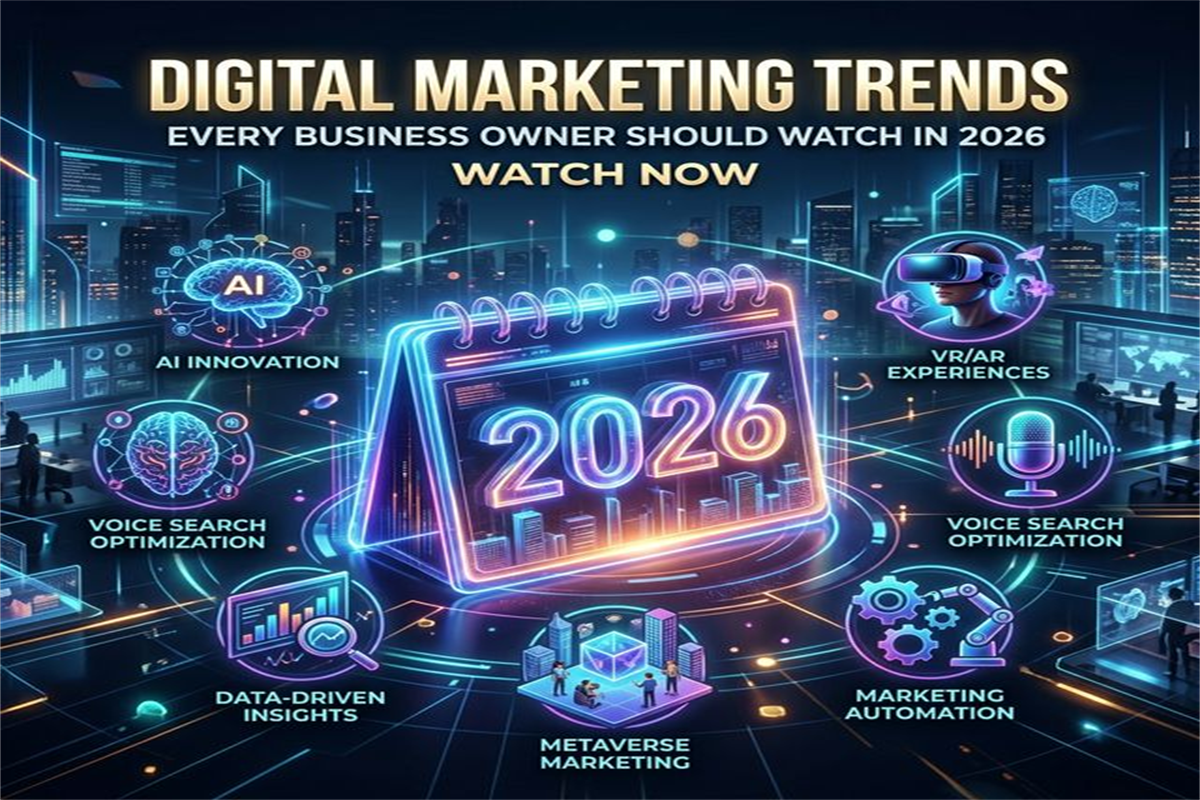
The digital marketing landscape never stops evolving, and 2026 is shaping up to be one of the most transformative years yet. From artificial intelligence reshaping how campaigns are created and optimized to the continued rise of video-first content and the decline of traditional search behaviors, the businesses that adapt fastest will capture the most market share.
For business owners, staying ahead of these trends is not about chasing every shiny new tool but about understanding which shifts will fundamentally change how customers discover, evaluate, and choose brands. The strategies that worked in 2024 are already losing effectiveness, and the gap between forward-thinking businesses and those stuck in outdated methods is widening rapidly.
In this comprehensive guide, we break down the most impactful digital marketing trends of 2026, explain why each matters for your business, and provide actionable steps you can take to capitalize on them. Whether you are a startup or an established enterprise, these insights will help you make smarter marketing investments this year.
AI-Powered Marketing Takes Center Stage
Artificial intelligence is no longer a futuristic concept in marketing. It is the present reality. In 2026, AI is integrated into virtually every aspect of digital marketing, from content creation and ad optimization to customer service and predictive analytics. Businesses that strategically leverage AI tools are seeing dramatically improved efficiency and results.
AI-powered content tools can now generate first drafts, analyze content performance, suggest topic ideas, and optimize existing content for search engines. However, the key word is "assist." The most successful content marketing services use AI as an efficiency multiplier while maintaining human oversight for strategy, creativity, and brand voice. Purely AI-generated content without human refinement often lacks the depth and nuance that builds genuine authority.
In advertising, AI is transforming campaign management. Platforms like Google and Meta now use machine learning to automatically optimize bidding, targeting, and creative elements in real time. Google Ads management in 2026 requires understanding and leveraging these AI features rather than fighting them. Smart bidding strategies powered by AI consistently outperform manual approaches when fed with proper data and conversion signals.
Predictive analytics powered by AI helps businesses anticipate customer behavior, identify churn risks, and personalize outreach at scale. By analyzing patterns in historical data, AI can predict which leads are most likely to convert, which customers might leave, and what products individual users are most likely to purchase next.
For business owners, the practical advice is straightforward: start integrating AI tools into your workflow now, but maintain human strategic oversight. AI excels at execution and pattern recognition; humans excel at strategy, creativity, and relationship building.
Voice Search Optimization
Voice search has moved from novelty to mainstream. With smart speakers in millions of homes and voice assistants built into every smartphone, an estimated 50% of all searches are now conducted by voice. This shift fundamentally changes how people search and, consequently, how businesses need to optimize their content.
Voice queries are longer, more conversational, and often phrased as questions. Instead of typing "best Italian restaurant Mumbai," a voice searcher says "What is the best Italian restaurant near me that is open right now?" This means your best SEO services in India strategy must evolve to target natural language queries and question-based keywords.
To optimize for voice search, focus on creating content that directly answers specific questions in a conversational tone. FAQ pages become particularly valuable because they naturally match the question-and-answer format of voice queries. Structured data markup helps search engines understand your content and feature it in voice search results.
Local businesses stand to gain the most from voice search optimization. A significant percentage of voice searches have local intent, with users asking for nearby businesses, operating hours, and directions. This makes investing in comprehensive local SEO strategies essential for capturing voice search traffic.
The Dominance of Short-Form Video
Short-form video is not just a trend. It is the dominant content format of 2026. TikTok, Instagram Reels, and YouTube Shorts have collectively reshaped how audiences consume content, and the impact on marketing cannot be overstated. Users now spend an average of 95 minutes per day watching short-form video content.
For businesses, this presents an enormous opportunity. Short-form video delivers the highest engagement rates of any content format and is uniquely effective at building brand awareness, demonstrating products, and creating emotional connections with audiences. Social media marketing strategies that do not include video are leaving significant growth on the table.
The barrier to entry for video content has never been lower. Smartphone cameras produce professional-quality footage, and free editing tools make production accessible to businesses of any size. What matters most is authenticity, value, and consistency, not production budgets.
Professional video editing services can elevate your raw content into polished, on-brand videos that stand out in crowded feeds. Even simple enhancements like captions, branded intros, and strategic cuts significantly improve engagement and retention rates.
YouTube marketing services remain essential because YouTube continues to be the second-largest search engine and a primary platform for both short and long-form video discovery. A presence on YouTube compounds over time as videos continue generating views and traffic for months and years after publishing.
Ready to Future-Proof Your Marketing Strategy?
Our team stays ahead of every digital marketing trend so you do not have to. We build custom strategies that leverage the latest technologies and platforms to deliver measurable growth for your business.
Get a Free ConsultationZero-Click Searches and Featured Snippets
One of the most significant shifts in search behavior is the rise of zero-click searches, where users get their answer directly from the search results page without clicking through to any website. Google's AI Overviews, featured snippets, knowledge panels, and instant answers now satisfy many queries without requiring a click.
For businesses that rely on organic search traffic, this trend requires a strategic pivot. Rather than panicking about declining click-through rates, smart businesses are adapting by optimizing for featured snippets and position zero results that display their brand prominently even in zero-click scenarios.
Investing in professional SEO company expertise is crucial for navigating this landscape. Modern SEO strategies must include structured data markup, concise answers to common questions, and content formatted specifically for snippet extraction. The goal is to be the source that Google references, building brand awareness and authority even when direct clicks decrease.
Additionally, creating content that targets complex queries, comparison searches, and deep-dive topics that cannot be fully answered in a snippet drives clicks from users who need more comprehensive information. The key is balancing snippet-optimized content for visibility with in-depth content that earns clicks.
Hyper-Personalization at Scale
Generic marketing messages are increasingly ineffective as consumers expect tailored experiences. Hyper-personalization uses data and AI to deliver individualized content, recommendations, and offers to each user based on their behavior, preferences, and stage in the buying journey.
Email marketing has evolved from basic segmentation to dynamic content that changes based on each recipient's past interactions, browsing behavior, and purchase history. E-commerce sites now display personalized product recommendations that account for individual preferences. Ad platforms deliver creative variations optimized for different audience segments automatically.
Personalization extends to website experiences as well. Modern professional web development can incorporate dynamic content that adjusts based on visitor characteristics. A returning visitor might see different messaging than a first-time visitor. A visitor from a specific industry might see relevant case studies and testimonials.
The businesses achieving the best results with personalization are those that balance relevance with privacy. Customers want personalized experiences but they also want to feel respected, not surveilled. Transparent data practices and genuine value exchange are the foundations of effective personalization.
The Rise of First-Party Data
The deprecation of third-party cookies and increasing privacy regulations have made first-party data one of the most valuable business assets in 2026. First-party data is information you collect directly from your customers and website visitors with their consent, and it is more reliable, more ethical, and more effective than third-party alternatives.
Building a robust first-party data strategy starts with creating genuine value exchanges that motivate visitors to share their information. Lead magnets, email newsletters, loyalty programs, interactive tools, and exclusive content are all effective methods for collecting first-party data.
This data powers more effective advertising campaigns, particularly on platforms like Google and Meta. Google Ads management strategies that leverage first-party data through customer match and enhanced conversions consistently outperform campaigns relying solely on platform-based targeting.
Your email list remains one of the most important first-party data assets. Unlike social media followers or search rankings, your email list is an owned asset that no algorithm change can take away. Building and nurturing an engaged email list should be a top priority for every business.
The Evolution of Influencer Marketing
Influencer marketing continues to grow but has matured significantly. The era of paying mega-influencers for generic sponsored posts is giving way to more strategic, authentic, and measurable partnerships. In 2026, micro and nano-influencers with smaller but highly engaged and niche-specific audiences deliver the best ROI.
Brands are shifting from one-off sponsored posts to long-term ambassador relationships that feel genuine. When an influencer consistently uses and recommends a product over months, their audience's trust in that recommendation deepens dramatically compared to a single paid post.
User-generated content from satisfied customers has become the most trusted form of social proof. Encouraging and curating authentic customer content through effective social media marketing strategies generates trust signals that polished brand content simply cannot match.
Augmented and Virtual Reality in Marketing
Augmented reality is crossing the threshold from experimental to practical for mainstream marketing. AR features that let customers visualize products in their space, try on items virtually, or interact with 3D brand experiences are increasingly available and expected.
For e-commerce businesses, AR-powered product visualization reduces purchase hesitation and return rates. For service businesses, virtual office tours and interactive presentations create immersive experiences that differentiate them from competitors. While full virtual reality marketing remains niche, AR is accessible to businesses of all sizes through social media platform features and increasingly affordable development tools.
Sustainability and Purpose-Driven Marketing
Consumers in 2026 increasingly choose brands that align with their values. Sustainability, social responsibility, and authentic purpose-driven messaging have moved from nice-to-have differentiators to business essentials. Studies show that 73% of global consumers are willing to change their consumption habits to reduce environmental impact.
However, authenticity is paramount. Greenwashing, the practice of making misleading environmental claims, backfires spectacularly in an age of social media scrutiny. Effective sustainability marketing communicates genuine efforts, acknowledges imperfections, and invites customers into the journey rather than making grandiose claims.
Purpose-driven content marketing services help brands communicate their values authentically through storytelling, behind-the-scenes content, and transparent reporting on social and environmental impact.
Your 2026 Action Plan
With so many trends competing for attention, here is a prioritized action plan for business owners:
1. Audit your current strategy. Evaluate which of your existing marketing activities align with these trends and which are becoming outdated. This honest assessment is the foundation for strategic investment decisions.
2. Invest in video content. If you are not creating short-form video yet, start now. This is the most impactful single change most businesses can make in their marketing mix. Even simple, authentic videos outperform static content.
3. Update your SEO approach. Work with a professional SEO company to optimize for voice search, featured snippets, and zero-click scenarios. Ensure your website uses structured data markup and targets conversational queries.
4. Build your first-party data assets. Create compelling lead magnets, grow your email list, and implement proper data collection with clear consent. This investment will become increasingly valuable as third-party data sources diminish.
5. Embrace AI tools strategically. Identify specific areas where AI can improve your efficiency, such as content creation, ad optimization, or customer insights. Start with one or two tools and expand as you build confidence.
6. Prioritize authenticity. Across all channels and formats, authentic, human-centric communication outperforms polished but impersonal corporate messaging. Let your brand's personality and values shine through in everything you create.
The businesses that thrive in 2026 will not be those that adopt every trend simultaneously but those that strategically select the trends most relevant to their audience and execute them with consistency and quality. For more strategic insights, explore our digital marketing blog or get a free consultation to discuss your specific growth opportunities.
Stay Ahead of the Competition in 2026
Our digital marketing experts help businesses navigate the rapidly evolving landscape with strategies that deliver real results. From SEO and content marketing to paid advertising and social media, we build comprehensive growth plans tailored to your business.
Get a Free ConsultationFrequently Asked Questions